Private Flight vs Commercial Flight: What's the Difference?
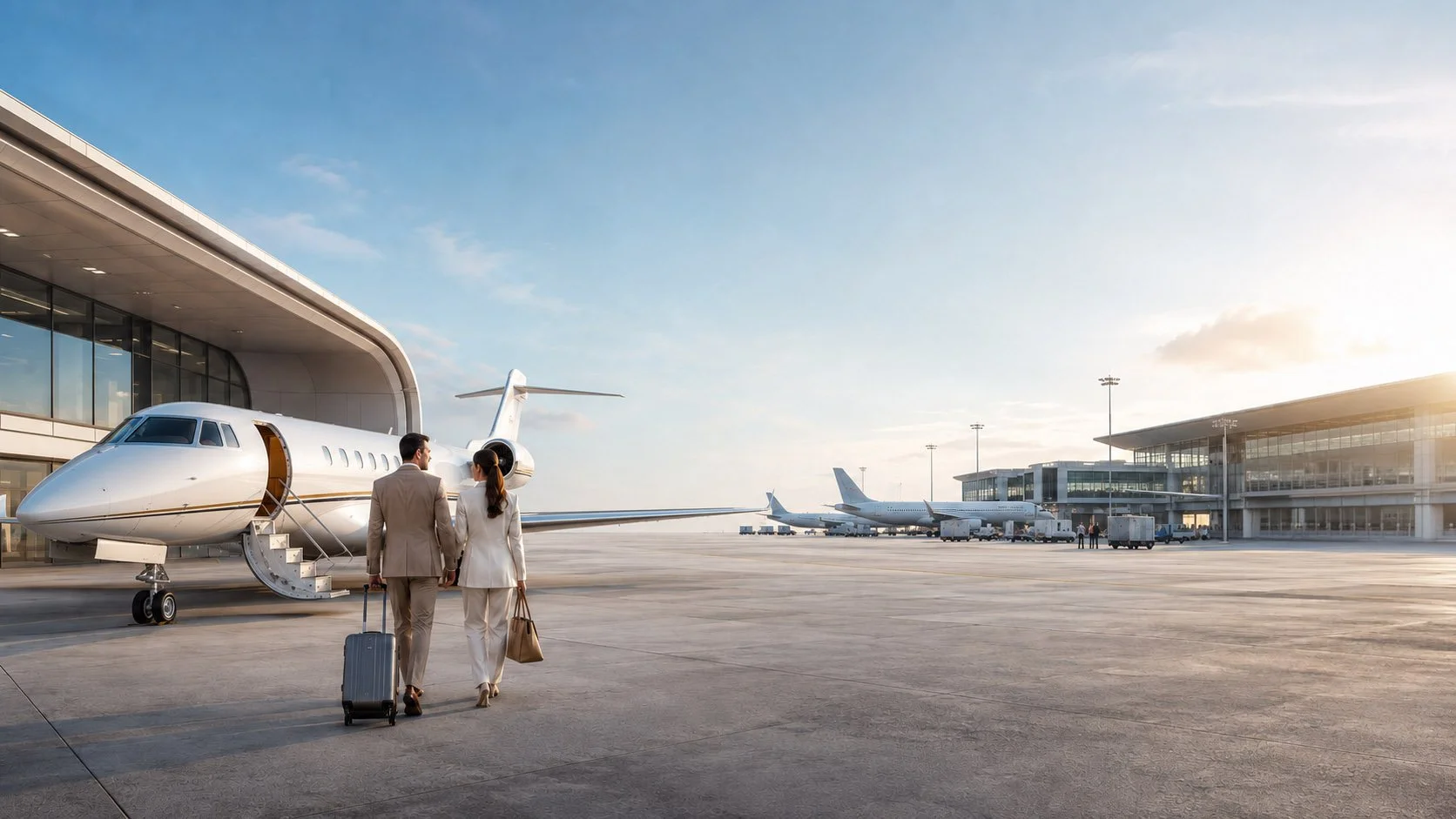
Every trip starts with a choice, long before you ever board. Do you fly commercial or private?
For most people, that choice has always been simple, because commercial has always been the default. But more travelers are stopping to ask a real question: what is the actual difference between a private flight vs commercial flight, beyond the price tag?
The answer touches nearly every part of the travel day: how you get to the airport, how you board, how much room you have in the air, and how much of your schedule you actually control.
WrenJet Private Air Charter works with travelers weighing this exact decision every week. As an ARGUS Certified Broker, an Air Charter Association member, and a member of the National Business Aviation Association, we help clients understand not just the cost difference, but what changes about the trip itself once you leave commercial travel behind.
Understanding the Main Difference Between Private and Commercial Flights
At the most basic level, both get you from one airport to another. That is where the similarities end.
Commercial flights operate on a fixed schedule, a fixed route, and a fixed cabin shared with hundreds of strangers. You adjust your day around the airline.
A private jet flips that entirely. The departure time, the aircraft, and the route are built around you and the people flying with you.
That single shift changes almost everything else about the experience, from the moment you leave home to the moment you land.
Airport Experience and Boarding Process
Nowhere is the difference more obvious than at the airport itself. The process of getting from your car to your seat looks almost nothing alike between the two.
Boarding a Commercial Flight
Boarding a commercial flight usually starts long before the flight itself. Airlines recommend arriving at least two hours early for domestic travel, and closer to three for international.
From there, it is check-in counters, bag drop, security lines, and a walk through a crowded terminal to reach the gate. Boarding happens in groups, often with a wait at the jet bridge before you're even in your seat.
By the time the aircraft pushes back, many passengers have already spent two or three hours in the process, before a single mile of the actual trip.
Boarding a Private Flight
Boarding a private flight looks almost nothing like that. Passengers typically arrive 15 to 30 minutes before departure, park close to the aircraft, and walk directly from the car to the cabin.
There is no shared security line, no long walk through a terminal, and no boarding group to wait for. Bags are handled without a check-in counter, and departure happens on your schedule rather than a fixed slot on a board.
For many travelers, this single difference in the boarding process is what makes the comparison between private flight vs commercial flight feel less like a luxury decision and more like a practical one.
Private Jet vs Commercial Flight Speed
Speed is not just about how fast the aircraft flies. It is about how fast the entire trip moves, door to door.
Commercial airliners often cruise faster in raw terms, but that speed is offset by connections, layovers, and the extra hours spent moving through terminals on both ends of the trip.
Private aircraft make up the difference by flying direct and by accessing smaller airports that commercial carriers simply do not serve. A private jet charter can often reach a destination in a single direct hop that would otherwise require a connection through a major hub.
The result is that a private jet vs commercial flight comparison often favors private travel on total trip time, even when the aircraft itself is not necessarily faster in the air.
Comfort and Privacy Comparison
Comfort is one of the most immediately noticeable differences once you're in the air, and it comes down to three things: privacy, space, and amenities.
Privacy
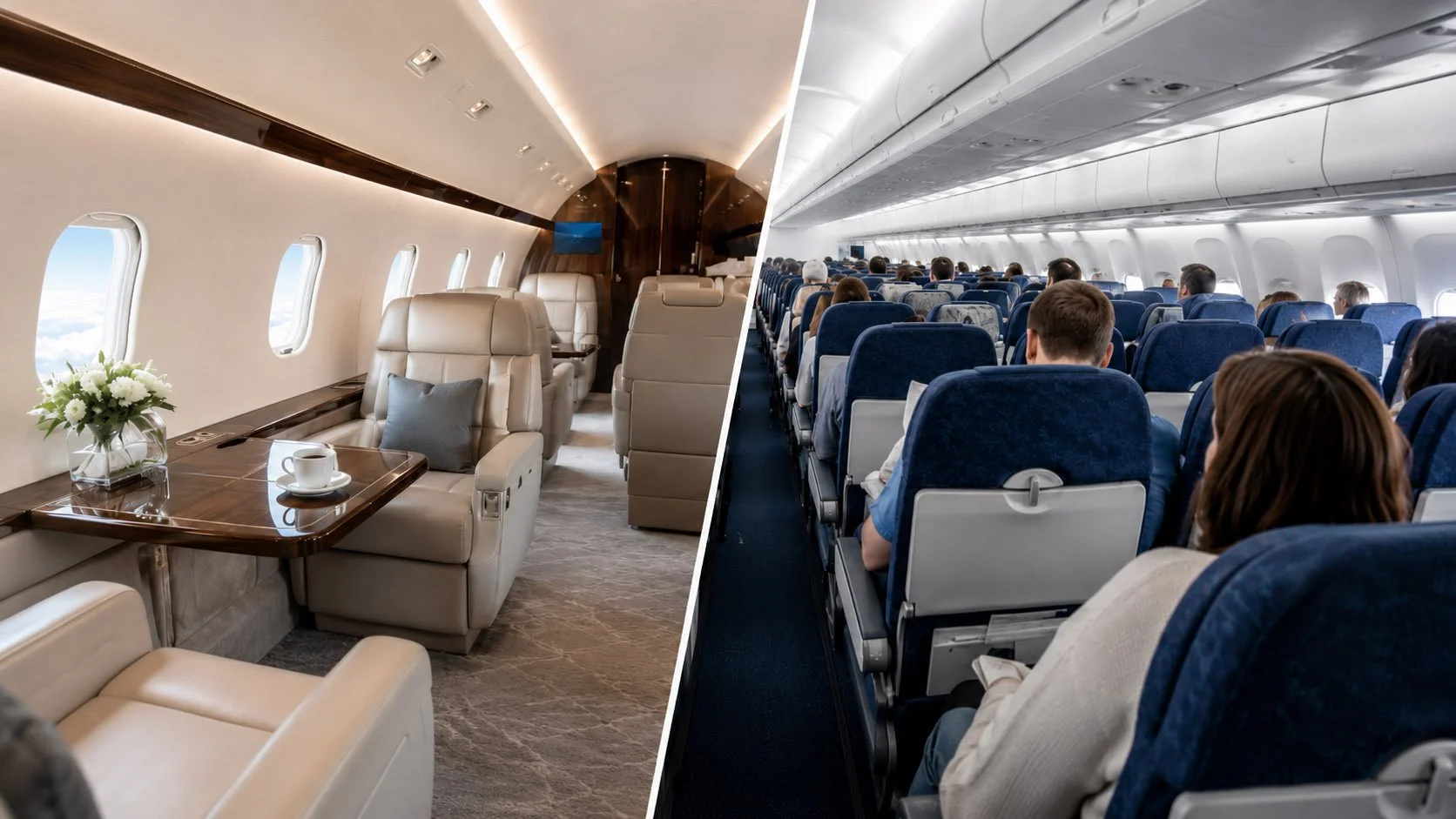
Commercial cabins are shared, public spaces by design. Even in first class or business class, you're still surrounded by other passengers, crew, and the general noise of a full aircraft.
Private aviation offers a different kind of environment entirely. Fewer touchpoints, fewer strangers, and a cabin that belongs to your group alone for the duration of the flight.
Space
Commercial seating, even in premium cabins, is designed to maximize the number of passengers who can fit on the aircraft. Private cabins are built around how the people flying actually want to use the space.
That means room to stretch out, work, rest, or simply move around without asking a row of strangers to let you by.
Amenities
Charter flights are typically stocked to the group's preferences rather than a standard galley cart. Meals, snacks, and even the cabin temperature can be tailored to the passengers on board, something commercial air travel, even in its premium cabins, rarely offers to the same degree.
Flexibility and Scheduling Differences
Commercial air travel runs on the airline's calendar, not yours. Flights are scheduled months in advance and shared with everyone else booked on that route. If your plans change, you're often working within a limited set of rebooking options.
Flying private removes that constraint almost entirely. Departure times can be set around your itinerary, and if plans shift the day before or even the morning of, the schedule can often shift with them.
For travelers juggling tight meeting schedules, connecting trips, or last-minute changes, this flexibility is frequently the deciding factor between flying commercial and choosing private jet travel.
Comparing Aircraft and Passenger Experience
Commercial travel offers a narrow range of choices: economy, premium economy, business class, or first class, all on the same aircraft, on the same route, at the same time as hundreds of other travelers.
Private travel offers a wider range of aircraft, sized and configured around the trip itself. A short regional hop might call for a light jet, while a longer trip with a larger group might call for a midsize or heavy aircraft with more cabin space and range.
That flexibility means the aircraft is chosen to match the trip, not the other way around, something no commercial airliner can offer regardless of how much you're willing to pay for the ticket.
Are Private Jets Safer Than Commercial Airlines?
Safety is one of the most common questions travelers ask when comparing the two, and it deserves a straightforward answer.
Commercial airliners operate under one of the most heavily regulated safety systems in the world, and that track record is well established. Private aviation operates under its own strict regulatory framework, with additional layers of oversight available through independent safety auditors.
This is where working with a broker matters. WrenJet Private Air Charter reviews private pilots, aircraft maintenance records, and operator safety history before presenting any option to a client, adding a layer of vetting beyond what a standard booking site provides.
The honest answer is that both commercial and private aviation are held to rigorous safety standards. The real difference for travelers is how much visibility they have into that vetting process, and a knowledgeable broker gives you far more of it.
Cost Comparison: Private Jet Charter vs Commercial Flights
This is usually where the conversation starts, and it deserves an honest breakdown rather than a simple yes-or-no.
What You're Paying For
A private jet charter costs more per trip than a commercial flight ticket. That much is not in question. But the comparison is not just ticket price against ticket price.
Private travel bundles in the time saved, the flexibility gained, and the ability to fly an entire group on one fixed cost rather than paying per seat. For groups of four or more, that math often changes significantly.
When the Value Adds Up
The value case gets stronger with group size, trip frequency, and destinations that commercial carriers serve poorly. A family or business group flying together, or a route that requires flying through smaller airports with limited commercial service, often shifts the comparison in private travel's favor.
WrenJet Private Air Charter walks clients through this calculation using their actual trip details, rather than a generic price comparison, so the decision is based on real numbers.
Who Should Choose Private Jet Travel?
Private jet travel is not the right call for every trip, but there are clear situations where it makes sense:
Tight or unpredictable schedules, where a missed connection isn't an option
Group travel, where splitting a fixed cost across passengers changes the math
Destinations underserved by commercial airlines, especially routes through smaller regional airports
Trips where privacy and comfort matter, such as sensitive business travel or family vacations
Time-sensitive travel, where hours saved translate directly into value
If one or more of these apply to your next trip, the case for flying private tends to become clear quickly.
Book Your Private Jet Charter with WrenJet
Commercial and private travel are not really competing for the same trip. They serve different priorities: commercial travel optimizes for volume and fixed pricing, while private travel optimizes for time, control, and comfort.
Understanding the real difference between a private flight vs commercial flight makes it far easier to know which one actually fits your next trip.
At WrenJet Private Air Charter, we help travelers make that decision with real information instead of guesswork, matching the right aircraft to the right trip and walking first-time flyers through the entire process from start to finish.
Ready to see what private travel looks like for your next trip? Get a private air charter quote now!
Explore our private jet charter options, or learn more about booking your next private jet flight with WrenJet.
Request a Private Jet Charter Quote Today